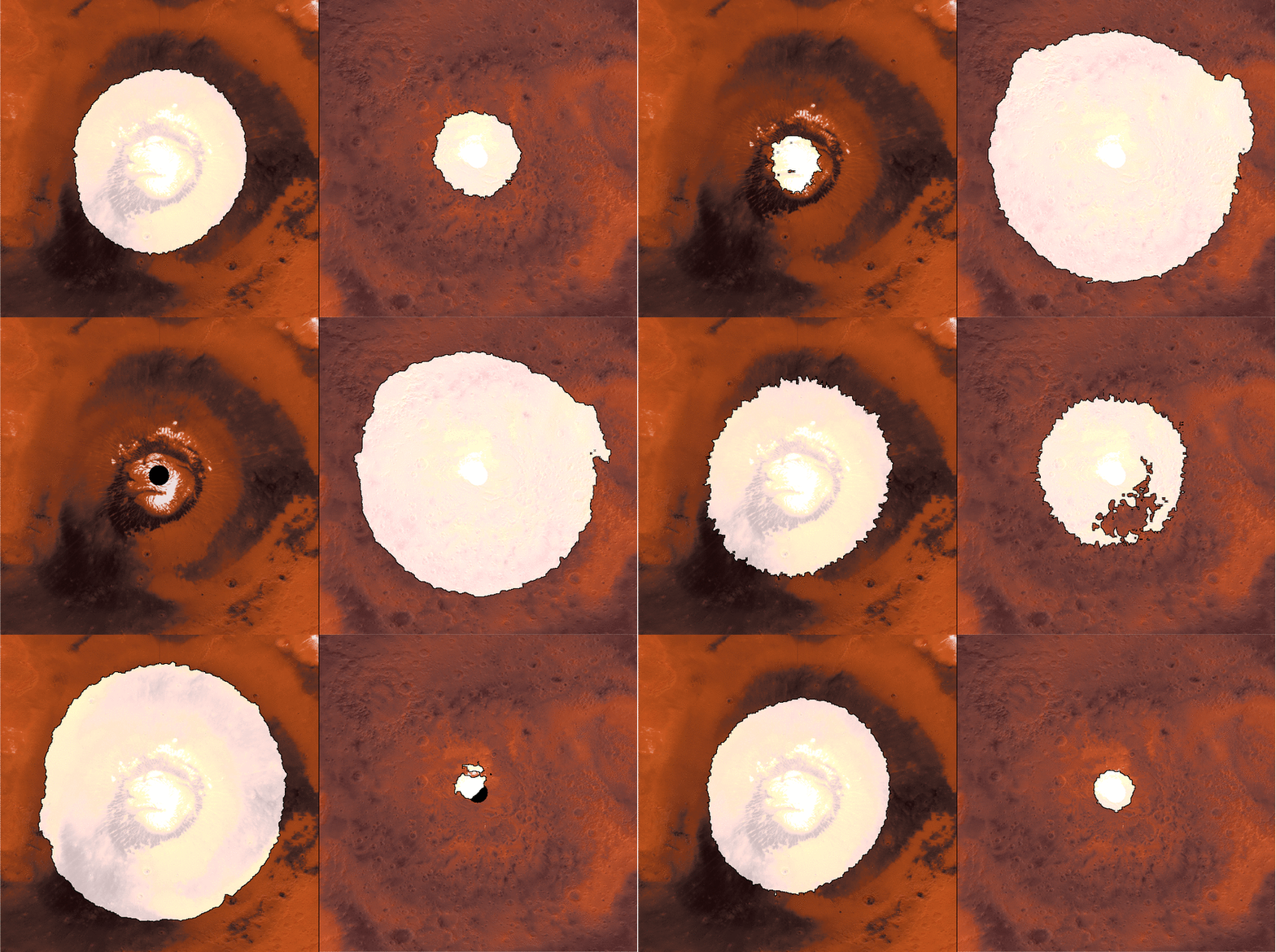
Ice on Mars has been of interest to planetary scientists, geologists, and astrobiologists for decades. It plays a key role in understanding Mars'- and by extension Earth's- geologic and climatic history. Since water and ice support life as we know it on Earth, martian ice holds great astrobiological value and supports future exploration of our Solar System. It follows that studying the nature of martian surface and subsurface ice can tell us a lot about the planet's history. Consequently, I am interested in exploring the cryo-geology of the Red Planet, and how it can inform our knowledge of its water-rich past.
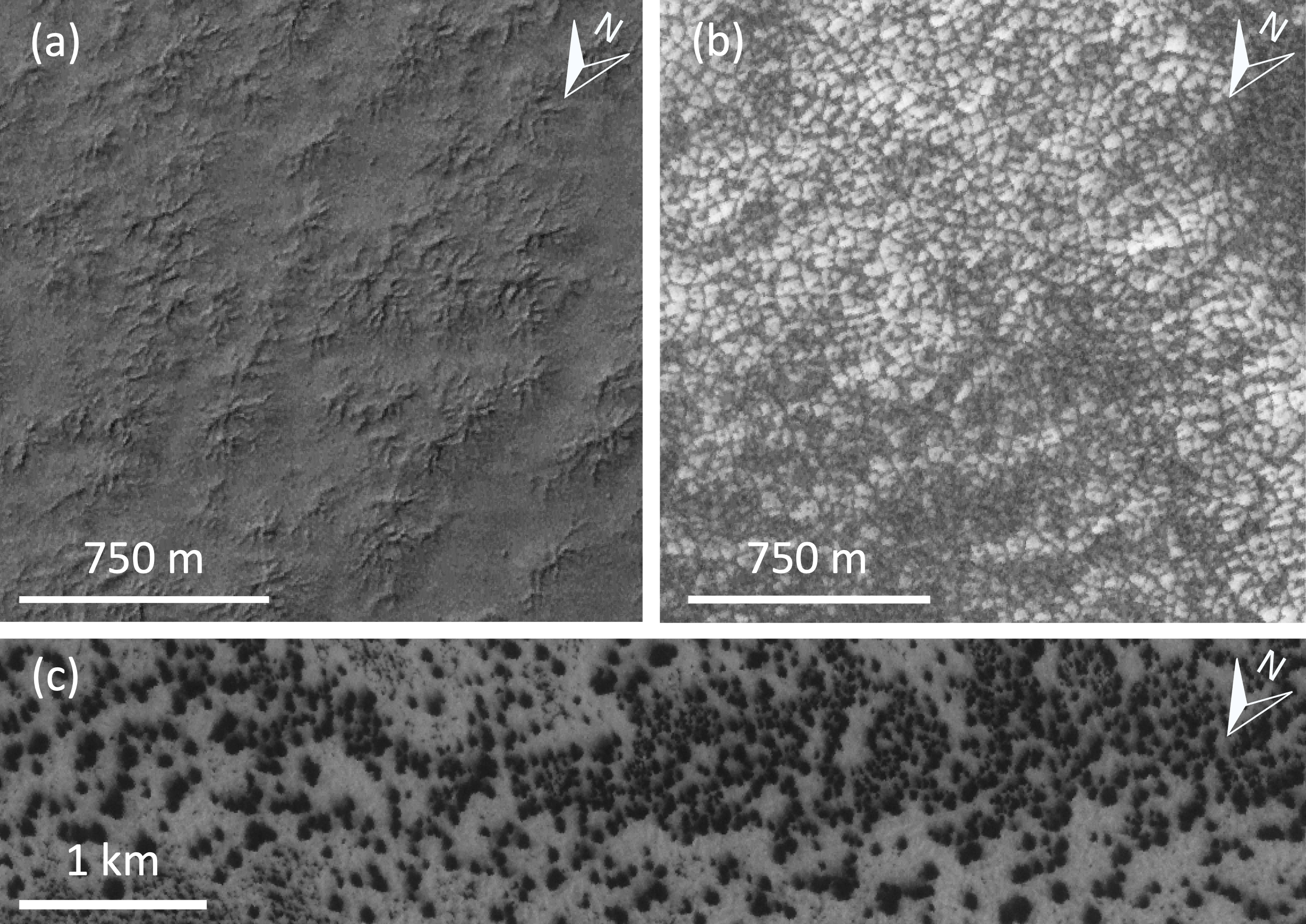
Araneiforms
Araneiforms, or spiders, are Martian CO₂ sublimation features with no known Earth analogs, characterized by a central depression with radially emerging dendritic troughs and thought to form through the seasonal extension and recession of CO₂ ice overlying the South Polar Layered Deposit (SPLD). This work investigates spider formation across distinct frost regimes to constrain the thermophysical context and past surface conditions under which these features form.

GPRPy
RIMFAX, the ground-penetrating radar aboard Mars 2020 Perseverance, probes more than 10 m into the Martian subsurface to capture stratigraphic evidence of the planet's wet and warm past. To support analog fieldwork for Mars 2020, I modified the open-source GPRPy software developed by Alain Plattner and colleagues to accommodate MALA GPR data collection, plot permittivity values on radargrams, and overlay GPS tracks on Google Earth.